

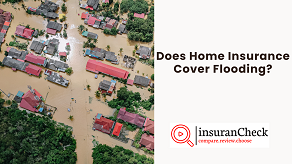
Last month, your neighbor had a flooded basement, resulting in $47,000 damage. Their insurance company rejected the entire claim.
They were covered by home insurance and had been paying premiums for years. However, when the water entered through their foundation, their insurer did not give them anything.
Here is the bitter truth: most likely, your home insurance won’t cover flooding. Most Americans are unaware of this fact until they face such a calamity. At that point, it is too late to remedy the coverage void.
This mistake costs homeowners billions of dollars annually. We’d better check that this isn’t your case.
Table of Contents
Does Your Standard Home Insurance Cover Flood Damage?
No. Flood damage is entirely excluded from standard homeowners insurance.
This is not some hidden clause or a small detail. It is a fundamental separation in almost all policies in America.
Flood damage refers to water entering from the outside of your property. Water is considered flood in cases such as rivers overflowing their banks, hurricane storm surges, or streets filled with heavy rain and then flowing into homes.
There is not even a chance that your regular policy will reimburse you a single dollar of these losses. You need to have a separate flood insurance plan.
Insurance companies explicitly state this in their policy documents. Nevertheless, most homeowners do not even glance at those papers until they have a claim to file.
What’s the Critical Difference Between Flood and Water Damage?
The deciding factor is where the water came from.
Flood Damage (Not Covered)
The water is coming from the outside and getting into your home. The cases that qualify are Hurricane storm surge, river overflow, snow melt accumulation, and surface water from heavy rain.
Your standard policy totally leaves out these types of incidents.
Water Damage (Covered)
The water comes from inside the systems of the house. The situations that fall here are burst pipes, leaking water heaters, damaged roof and the rain coming through it, or washing machine malfunction.
For these cases, your homeowners’ policy is responsible.
One can say it in this way: water that is moving from outside to inside of the house is considered a flood. And water that is escaping from inside systems is a covered damage.
How Often Do Floods Actually Happen in America?
It is much more frequent than you imagine.
Flooding causes nearly $8 billion in property damage each year across the United States of America. The figure increases with the intensification of weather patterns.
The statistics that shock people the most are as follows: According to FEMA, over one-fifth of flood insurance claims come from areas with moderate to low risk. One does not have to reside close to a river or sea to have a high chance of floods.
Cities are the targets of urban flooding. Old drainage systems fail to support the heavy rains. Water gets into streets, basements, and ground-floor apartments due to backup.
The areas where traditional flooding hasn’t occurred are the places where flash floods happen. Only one severe thunderstorm is enough to make a neighborhood flooded by dropping too much rain.
Climate patterns are changing. Places that have been dry for a long time are now experiencing regular flooding events.
What Does Flood Insurance Actually Protect?
There are two different categories that flood policies cover.
Building Coverage
This is the part of the policy that protects the physical structure of the house. The foundation, walls, floors, and the house’s electrical and plumbing systems are covered up to policy limits.
In addition, the protection of your HVAC system, water heater, appliances that are built-in, and flooring that is permanently installed will also be included.
Structural repairs after flood damage are expensive. Foundation work alone can run up to $20,000 or more.
Contents Coverage
It involves everything that is inside the home. Furniture, electronics, clothing, appliances, and personal belongings will be covered.
Coverage for contents is independent of that for the building. It will not be given to you automatically, and neither will the latter. You must intentionally acquire it.
Some homeowners do not opt for the content insurance because they want to cut down on expenses. And then they find themselves losing a fortune in the destruction of their properties.
Critical Exclusions
There are things that flood insurance won’t cover, such as large amounts of money, precious metals, important documents, and unregistered stocks.
Temporary or partial living expenses while repairs of homes are in progress are not among the inducements of standard NFIP policies. In other words, a hotel bill cannot be paid from flood insurance money.
Limited or no coverage is given to landscaping, swimming pools, hot tubs, and detached structures.
You may also read: Does Home insurance Cover Termite Damage? 2025 Guide
How Do You Actually Get Flood Insurance?
There are two ways to get coverage.
National Flood Insurance Program (NFIP)
Most flood insurance in the United States is under this program that is managed by the federal government. It was set up by Congress as the private insurers were rejecting the idea of taking the risk of floods.
The maximum coverage is $250,000 for the building and $100,000 for the contents. If you have a $400,000 home filled with stuff worth $150,000, the insurance will cover only a part of the loss.
Your flood zone and the height of your house determine the amount of the premiums. The properties that are at high risk of flooding pay significantly more.
Only after 30 days from buying the policy, is the waiting period mandatory. So if a hurricane is three days away, then a flood insurance cannot be purchased.
Private Flood Insurance
After being absent for decades, private insurers are gradually coming back into this market. The competition is increasing.
Compared to NFIP, privately held policies generally offer higher coverage limits. For instance, some of them can reach up to $4 million or more for luxury properties.
Insurance terms are very different from company to company. Some include the additional living expenses that can happen during a period of repairs, while others offer the new replacement at the cost rather than at the actual cash value.
Depending on your property, premiums may be lower or higher than NFIP. The best thing is that you can always compare both options.
What Does Flood Insurance Cost in America?
Costs vary dramatically based on your flood zone.
| Flood Zone | Risk Level | Average Annual Premium | What This Means |
| X (Shaded) | Moderate | $450 – $700 | Outside high-risk areas |
| X (Unshaded) | Low | $400 – $650 | Minimal flood risk |
| A Zones | High | $1,200 – $2,500 | Special Flood Hazard Area |
| V Zones | Highest | $2,500 – $5,000+ | Coastal high-velocity zones |
These are typical premiums for $250,000 building coverage with $100,000 contents coverage. Your actual cost depends on elevation, building type, and basement status.
Properties with basements pay more. Homes elevated above base flood elevation pay less.
The average NFIP policy costs around $985 annually. That’s roughly $82 monthly for protection against catastrophic loss.
Final Thoughts
Standard home insurance doesn’t allow for flood damage to be covered. Simply put, this is the only exception existing in every policy across the U.S.
At the moment, there are millions of Americans totally unprotected against flood losses. They are playing their financial security as though the weather patterns will continue to be stable.
Such a bet is gone to lose. Flooding incidents are becoming more and more frequent and severe throughout the United States. Places that were never flooded are now suffering.
Do not wait until you need flood insurance to get one. The 30-day waiting period doesn’t allow you to panic-buy coverage when the storms are close by. Find out where your area is located in relation to the flood zone and get quotes from NFIP and private insurers. Carefully check and compare the coverage limits and costs.
The amount of money you pay today to prevent a financial disaster tomorrow due to floods. Avoid the situation where you have to find out about flood exclusions in an unpleasant way.